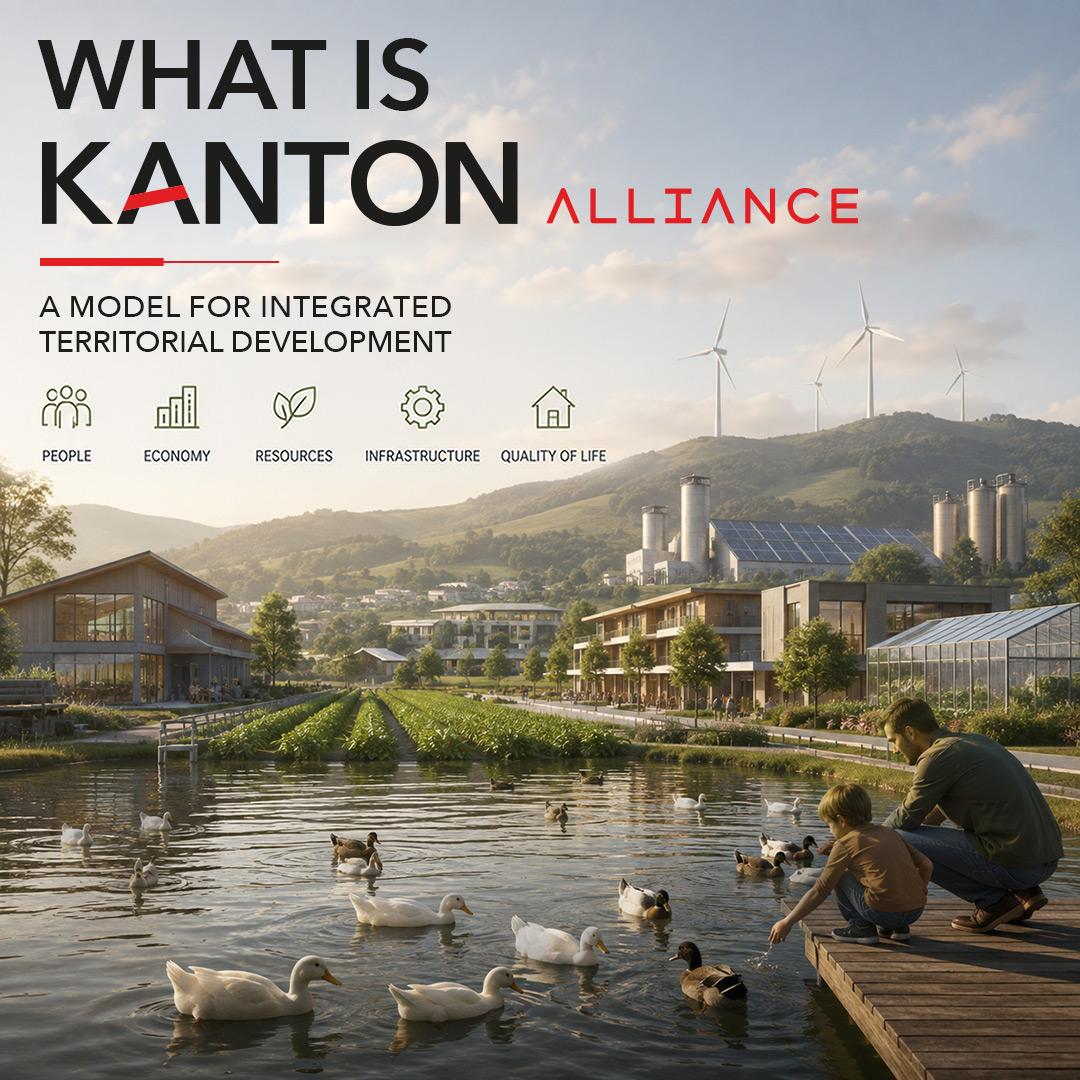
KANTON Alliance is an international initiative created to develop and implement a new model for integrated territorial development.
At the core of KANTON is a simple principle: a territory should not develop as a collection of separate projects, but as one connected economic, infrastructural and social system.
Today, many regions face similar challenges: population decline, youth migration, a shortage of jobs, outdated infrastructure, limited local processing, insufficient investment and dependence on external resources.
Too often, these challenges are addressed separately. Housing is developed without enough jobs. Agriculture grows without sufficient processing capacity. Businesses are created without the infrastructure they need. Investment projects are implemented without a shared long-term vision for the territory.
KANTON proposes a different approach.
What is KANTON?
KANTON is a model for the integrated development of an existing territory — a city, municipality, community, district or group of settlements.
Every territory is different. Each has its own population, land, businesses, agriculture, transport links, energy infrastructure, water resources, natural conditions and economic potential.
That is why a KANTON does not begin with construction. It begins with data and territorial analysis.
The first stage looks at:
-
population and human capital
-
land and natural resources
-
agriculture
-
existing businesses
-
energy
-
water
-
transport and logistics
-
engineering infrastructure
-
social infrastructure
-
markets and investment opportunities
Based on this information, the economic profile of the territory can be defined and a long-term Master Plan can be developed.
Economic Development Starts with Jobs
One of the fundamental principles of KANTON is: economic activity and jobs come first, followed by sustainable territorial growth.
New production facilities, agricultural processing, energy projects, logistics, services and other business activities create employment. Employment, in turn, creates demand for housing, education, healthcare, retail, transport, services, sports and public infrastructure.
This allows a territory to grow around a real economy rather than around an isolated residential project.
The goal of KANTON is to create places where people can not only live, but also work, learn, build careers, access modern infrastructure and see long-term opportunities for themselves and their families.
Key KANTON Clusters
Depending on the characteristics and potential of each region, different economic and infrastructure clusters can be integrated into the KANTON model.
Agriculture & Food
Agriculture, livestock farming, storage, processing and food production. The objective is to increase the amount of value created locally rather than exporting raw resources alone.
Industry & Production
Industrial enterprises, local processing, building materials, prefab technologies and other forms of local production.
Energy
Solar generation, BESS energy storage systems, biogas and other solutions designed to improve the energy resilience of the territory.
Water
Water sources, supply systems, treatment, storage, irrigation and water reuse.
Circular Economy
Turning organic, agricultural and other suitable waste streams into energy, fertilizer and secondary resources.
Housing & Urban Development
Modern housing, the development of existing settlements and the creation of a high-quality urban environment.
Education & Human Capital
Schools, vocational education and workforce development aligned with the needs of the local economy.
Health & Social Infrastructure
Healthcare, sports facilities, public spaces and other forms of social infrastructure.
Logistics
Roads, rail infrastructure, warehouses, transport corridors and logistics hubs.
Commerce & Local Business
Retail, services, small and medium-sized businesses and the development of stronger local markets.
Digital & Smart Infrastructure
GIS, Digital Twin systems, digital planning, infrastructure monitoring and management.
Recreation & Tourism
Natural areas, sports, tourism, wellness and the development of an attractive living environment.
Every KANTON is structured differently according to the resources and opportunities of its territory.
Building an Interconnected Economy
One of the key features of the KANTON model is the connection between different sectors and resources. For example:
agriculture → processing → finished product → market
livestock and organic residues → biogas → energy → organic fertilizer → agriculture
water → use → treatment → reuse → irrigation
local production of building materials → housing and infrastructure
new businesses → jobs → new residents → services → territorial growth
In this model, the output or by-product of one sector can become an input for another. This enables the territory to create more value locally, use its resources more efficiently and reduce dependence on external factors.
How a KANTON Is Developed
The model follows a structured development process.
01 — Territory Selection
Identification of a suitable territory together with local partners and public authorities.
02 — GIS & Resource Analysis
Analysis of land, population, economy, businesses, agriculture, energy, water, infrastructure and logistics.
03 — Economic & Cluster Model
Definition of the territory's economic profile and identification of its most promising economic clusters.
04 — Master Plan
Spatial integration of production, housing, infrastructure, social functions and the natural environment.
05 — Engineering & Technologies
Selection of appropriate engineering, technology and infrastructure solutions.
06 — Investment Model
Breaking the overall development programme into specific investment projects and identifying suitable financing mechanisms.
07 — Implementation
Phased implementation together with public, municipal, private and international partners.
The Role of KANTON Alliance
KANTON Alliance is being developed as an international integration and coordination platform.
Its role is to bring together around a specific territory: public authorities, municipalities, local communities, architects, engineers, technology companies, industry, agriculture, universities, financial institutions and private capital.
KANTON Alliance is not intended to replace existing public or municipal institutions. Its role is to connect territory, expertise, technology and capital within one implementable development model.
From Individual Territories to an International Network
Every KANTON can have its own economic specialization. One territory may focus on agriculture and food processing, another on energy, industry, logistics or construction technologies.
Over time, these territories can cooperate with one another, exchange technologies and products, build shared value chains and access new markets together.
In this way, individual projects can gradually become part of an international network of interconnected territorial economies.
Our Mission
The mission of KANTON Alliance is to create territories where economic development directly contributes to a better quality of life.
WORK • LIVE • PRODUCE • LEARN • ENERGY • WATER • FOOD • TECHNOLOGY • COMMUNITY
Not to develop territories around isolated projects. To build an integrated system around people, the economy and the future of the region.
KANTON Alliance — Building Sustainable Territories.