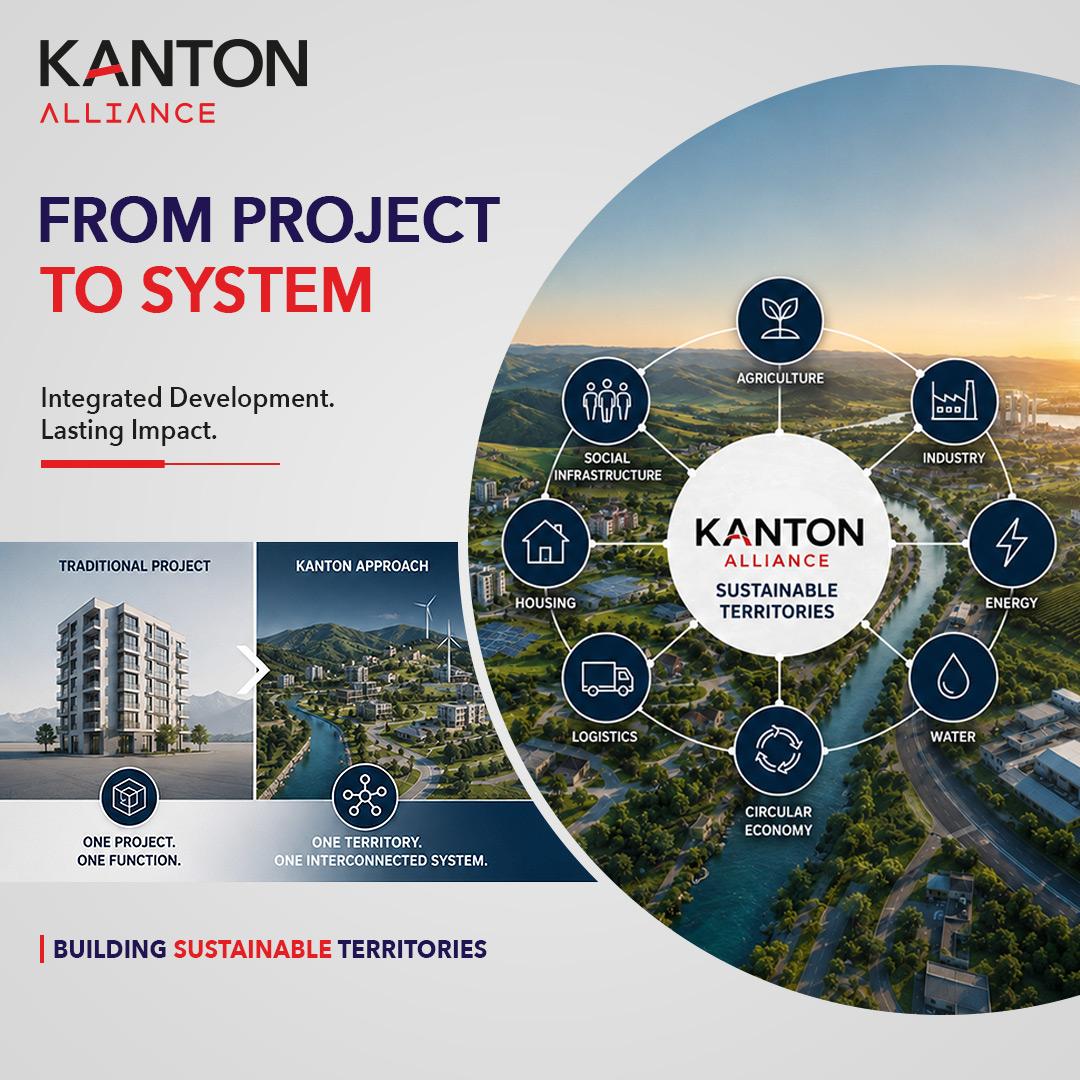
Most development projects begin with a physical asset: a residential complex, an industrial site, a business park, or a piece of infrastructure. A site is selected, a concept is developed, buildings and utilities are designed, and construction follows.
KANTON takes a different approach. We do not start with construction. We start with the territory as an integrated system.
Before the first buildings are developed, it is necessary to understand how the territory will function and evolve: what economic activities can operate there, where jobs can be created, how energy and water will be supplied, and how transport, agriculture, production, digital infrastructure and other essential functions will work together.
Not isolated assets, but interconnected systems
Housing, industry, energy, agriculture, water, mobility, education, services and digital infrastructure do not exist independently. A decision made in one area inevitably affects the others.
KANTON therefore approaches the territory as a whole. Different systems are brought together within a single model, making it possible to identify relationships between them, evaluate development scenarios and make better-informed decisions before major capital investment begins.
Digital modelling, data and modern technologies make it possible to compare alternative scenarios and understand the potential consequences of decisions before they are implemented in the physical world.
Economy before infrastructure. Infrastructure before construction.
A building alone does not create a sustainable territory.
Long-term development requires an economy capable of creating employment and generating demand. It requires infrastructure that supports that economy and provides a high quality of life. Only then does construction become part of a broader functioning system.
This is why the KANTON approach follows a clear sequence: first, the potential of the territory and its economic model are defined; next, the infrastructure required to support that model is designed; and only then is the physical environment developed.
A territory designed to evolve
The objective of KANTON is not simply to build another residential district or industrial site. It is to create the conditions for a territory to develop over the long term, adapt to change and use its resources more efficiently.
This approach brings businesses, investors, public institutions, technology companies, scientific and educational organisations, and local communities into a shared development framework.
The conventional model builds assets. KANTON builds the system in which those assets become part of a functioning territory.